1 Published BooksLuca Evola
Verbally mystifying this untold love story expands the reaches and possibilities of the written word with new and exciting layers of storytelling. A relationship both forbidden and illicit comes this cautionary heart-throb about two daring and naive lovers who follow their hearts despite their fear of becoming outcasts. An excruciatingly cruel and absolutely perfect torment teeming with angst and taut with every convincing fear that is close to the heart.
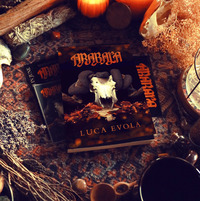
A soft archaic revival depicting the ancient goddess and rooted in symbolism, Arabala is a compound of “Arab” and “Bala”, or “Arab” and “Ala, Allah” (God), together meaning “Arab goddess” or “Arab divine”. “Bala,” means youth, aphrodisiac, and is associated with Bala Tripura Sundari Yantra, the ancient Hindu Goddess of beauty and grace. You can even see the word “Bella” as in “beautiful”. Bala बल in Sanskrit means “young,” “powerful,” and “strength of mind.” In Arabic, “Bala” can also mean “distress,” or “adversity.” “Consort of” or antecedent to Allah, “Allat”, also called Al-Lat, Lat, or Alilat was a pre-Islamic goddess worshipped all throughout the Middle East. She has been associated with the Greek Athena and her Roman equivalent Minerva. The Temple of Allat closed during the persecution of the pagans during the late Roman Empire. The Islamic prophet Muhammad ordered the destruction of Al-Lat’s shrine, and with him, the Goddess cult was eradicated from Arabia. Subsequently, an era of patriarchally structured culture and religion began which still lasts to the present day. The Lion of Al-Lat depicts a lion and a gazelle, the lion representing her masculine consort, and the gazelle representing Allat’s tender and loving traits. She is a solar deity associated with vegetation, grains, fertility and abundance, and was once worshipped by seven naked priestesses who circled the Kabaa in Mecca seven times. The seven rounds represent the seven planets that were then known, the Sun, the Moon, Venus, Mars, Saturn, Jupiter and Mercury. The black Kabaa looks like a vulva and was used by women who would rub their genitals against it to increase their fertility. The black Egyptian asp woven into the ram skull represents the divine feminine yin or the snake in the garden of Eden, which is Sophia, or holy female wisdom. The ram or bull skull is the archetype of the womb, the bucrania, a downward facing triangle or the Egyptian hieroglyph for uterus which is “V”. From neolithic times up until fifteen hundred years ago, the Great Mother was honored virtually everywhere on earth. But over many centuries of crusades and the burning of temples and scrolls most cultures gradually lost their traditions of the Divine Mother after the systematic eradication of her image during the rule of the Egyptian pharaoh Akhenaten or Aten. The Roman Empire conducted their efforts in the same way.
Arabala is a modern Cinderella story which is also an ancient one. The Greek geographer and historian Strabo tells the earliest recorded variant of the folk tale in his Rhodôpis, the name of a Greek slave girl who married the King of Egypt. The white ram skull on the cover is the month of Capricorn when the two lovers reunite and when the sun is reborn, or in ancient physiology when there is an illumination of the pineal gland; a rebirth or death. The ram and snake both symbolize the word “transformation” and the sexual alchemical dance of lovers. The closed circle or ring is also symbolic of the goddess, signifying completeness and representing the natural cycles of life, birth, death, rebirth, and the infinite, and associated with the menstrual cycle and the phases of the moon. The circle is also zero in our system of numbering, and symbolizes potential, or the egg and embryo.
“God is a circle whose centre is everywhere and whose circumference is nowhere” —Empedocles
