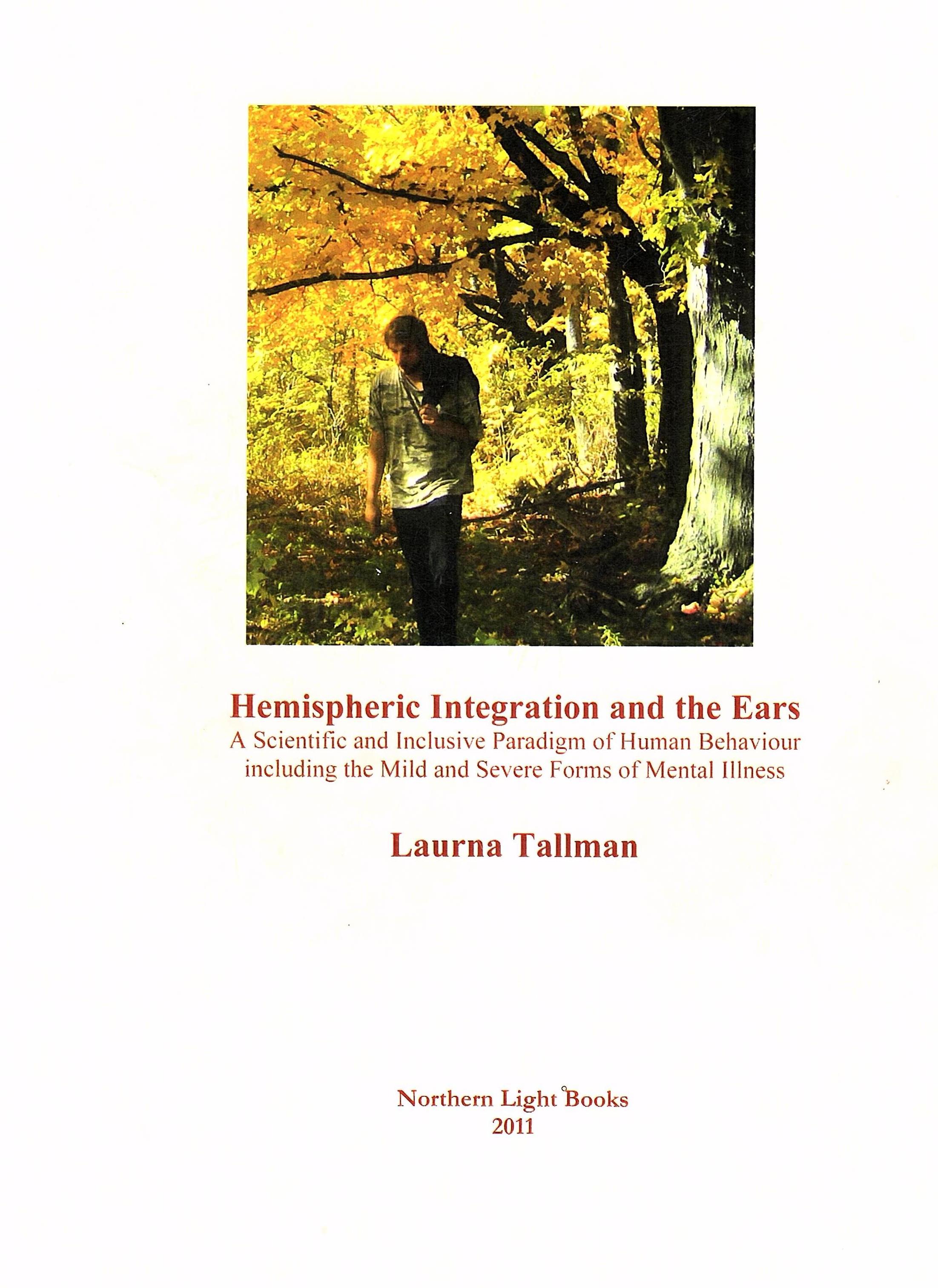
Hemispheric Integration and the Ears; A Scientific and Inclusive Paradigm of Human Behaviour Including the Mild and Severe Forms of Mental Illness
Hemispheric Integration and the Ears synopsizes the neurological and behavioral science in the author's first work, Listening for the Light ....
Also Available in:
- Amazon
- Audible
- Barnes & Noble
- AbeBooks
- Kobo
More Details
Hemispheric Integration and the Ears synopsizes the neurological and behavioral science in the author's first work, Listening for the Light . Streamlined for busy professionals and for highly motivated parents and caregivers of persons with mental illness, the Tallman Paradigm of right-ear-driven left cerebral dominance is a novel discovery useful to medicine, psychiatry, and psychology and for most disciplines in the humanities. The author analyzes schizophrenic and other mental illnesses in a paradigm that traces the etiology of these behaviors to right-ear stapedius muscles naturally weak or made dystonic, in her son's case by drugs (including even minuscule doses of medication) and loud sound. Her observations of her son's fluctuating cognition and other symptoms over a decade of recurring episodes of schizophrenia led the author to define schizophrenia as non-dominance of the cerebral extremely low speeds of hemispheric integration. Two long episodes of schizophrenia were terminated (2005-6; 2008) through ear focused listening to high-frequency sound, with integration enhanced by simple art activities. Tallman noticed that the phases her son passed through when developing schizophrenia were the same phases he passed through in reverse order during recovery. Those phases were characterized by the syndromes of schizophrenia, bipolar I, bipolar II, obsessive compulsive behavior, depression, dyslexia, then normal behavior. Tallman analyzes her son's grammatical structures, according to the delineation of the differing functions of the two halves of the brain by the American neurologist V.S. Ramachandran, as an inter-hemispheric duet that became more rational when his hemispheres integrated at increasing speeds. As soon as Daniel was taught that his brain was not broken but that he could learn to control his behavior by protecting and exercising his ears, he began to do so. Daily focused listening produced increasing facility with language and in all self-control whether physiological (e.g., nystagmus) or behavioral (e.g., decision-making). However, the condition of fully normal behavior appeared very suddenly when his left-brain dominance became self-sustaining through flexible stapedius muscle reactivity to his voice and to ambient sound, which also gave him the normal measure of volitional control of his ear. The author hypothesizes specific and distinctive ranges of audio-processing deficits corresponding to identifiable patterns of behavior, in line with the audio deficit profiles discovered by Dr. Guy Bérard. The author concludes, concomitant with the Tomatis Effect (1957), that Wernicke's area processes the morphemes received from the right ear in an order that is interrupted in schizophrenia due to alternating hemispheric dominance caused by stapedius dystonia (not through intrinsic failure). Thus, the author replaces speculative models of schizophrenia with a scientific paradigm of hemispheric non-integration with measurable parameters. Tallman explains cerebral integration disorders and normal behavior, disputes a leading theory of schizophrenia, and explains states and degrees of human consciousness as under semi-conscious or unconscious control of the ear states of consciousness from intense alertness in the left brain to drowsiness and day-dreaming in reduced integration, to the more fully right-brained consciousness of the subconscious : mystic states, sleep, and the dreams that most closely resemble the cerebral non-dominance of schizophrenia. The Appendix of 24 pages of artwork demonstrates the neurological and other physical maturational phases (ages 4 through 14) attained by the 28-year-old subject during the 10 months of his recovery from severe schizophrenia. Illustrations, diagrams, tables, notes, and appendices.
- Format:
- Pages: pages
- Publication:
- Publisher:
- Edition:first, First Edition
- Language:
- ISBN10:0981167217
- ISBN13:9780981167213
- kindle Asin:0981167217
About Author