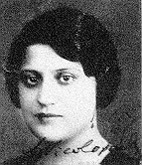
15 Published BooksDido Sotiriou
Dido Sotiriou (Greek: Διδώ Σωτηρίου) was born in Aϊdini of Asia minor, in 1909, the daughter of Evangelos Pappas and Marianthi Papadopoulou.
In 1919 she moved with her family to Smyrni (Izmir) but following the destruction of 1922 she fled to Greece. In Athens she completed her general education having as teachers the then literary figures Kostas Paroritis and Sophia Mayroeidis-Papadakis amongst others. She studied at the French Institute of Athens and in 1937 she briefly attended a course in French Literature at the University of Sorbonnis.
In 1936 she officially turned to professionally practicing Journalism. She worked for the magazine “Gynaika” (Woman) (as editor-in-chief) and then went on to work for newspapers “Neos Kosmos” (New World) and “Rizospastis” (The Revolutionist) (again as editor-in-chief from 1944), while during the duration of the German Occupation collaborating with Melpo Aksioti, Elli Alexiou, Elli Pappa, Titika Damaskinou, Elektra Apostolou, Chrysa Chatzivasileiou and other Greek women who were members of the Resistance.
In 1935 she took part in the congress of the Comity in Geneva, where she met Vladimir Ilyich Lenin’s comrade Alexandra Mikhailovna "Shura" Kollontai and in 1945 she took part in the founding congress of the Women’s International Democratic Federation in Paris.
She first appeared on the literary scene in 1959 with the publication of her first novel “Oi Nekroi Perimenoyn” (The Dead Await). Her works have been translated into many foreign languages.
Dido Sotiriou belongs to the Greek novelists of the 1920-1940 eras. Her work moves in the planes of realism with the presence of the self biographical element strong and the emotional participation of the author in the adventures of her protagonists. Her material is derived from the Asia Minor Disaster, the Civil War period and the period after the Civil War in Greece.
With “Matomena Chomata” (published as Farewell,Anatolia in English) Sotiriou initiated her course towards a style of writing that combined fiction with her own distinct way of examining her issues from a historical aspect.
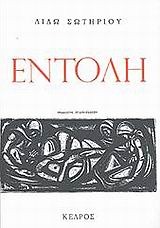
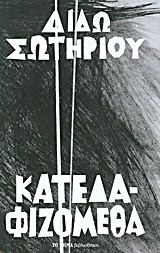
A course which continued and bled into her next two novels “Entoli” (The Command) which had as a theme the case of Mpelogiannis and “Katedafizometha” (Shattered).
She died in 2004.