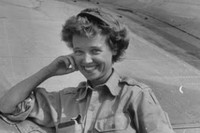
9 Published BooksMarguerite Higgins
Marguerite Higgins was born in Hong Kong. Her father, Lawrence Higgins, an American working at a shipping company, moved the family back to the United States in 1923.
Higgins was educated at the University of California. In her first year she worked on the student newspaper, The Daily Californian. After Higgins graduated in 1941, she moved to Columbia University where she completed a masters degree in journalism.
In 1942 Higgins was hired by the New York Tribune. Higgins wanted to report the war in Europe, but it was not until 1944 that her editor agreed to send her to London. The following year she moved to mainland Europe, first reporting the war from France and later in Germany. This included accompanying Allied troops when they entered the Nazi extermination camps of Dachau and Buchenwald.
After the war and covered the Nuremberg War Trials and the growing tension between west and eastern Europe for the New York Tribune. In 1947 Higgins was promoted to bureau chief in Berlin.
In 1950 Higgins was assigned to Japan where she became the newspaper's Far East bureau chief. On the outbreak of the Korean War, Higgins moved to South Korea where she reported the the fall of the capital, Seoul, to North Korean forces.
The New York Tribune sent their top war reporter, Homer Bigart, to South Korea and ordered Higgins to return to Tokyo. Higgins refused to go and continued to compete with Bigart to get the best stories. This became more difficult when all women reporters were banned from the front-line. Higgins was furious but was eventually able to persuade General Douglas MacArthur to allow her to resume her front-line reporting.
Higgins, who was with the Marines when they landed in Inchon, 200 miles behind the North Korean lines, on 15th September, 1950, soon established herself as an outstanding war journalist. Her more personal style of reporting the war was popular with the American public. In October, 1950, Higgins was the subject of an article in Life Magazine.
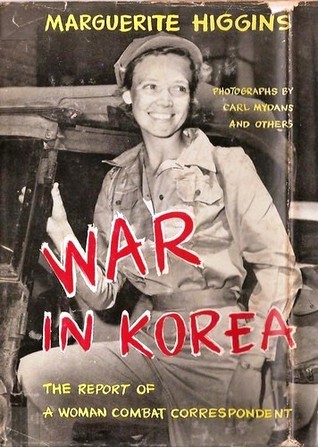
In 1951, her book, War in Korea, became a best-seller. That year she won the Pulitzer Prize for international reporting and was voted Woman of the Year by the Associated Press news organization.
Higgins was sent to Vietnam in 1953 where she reported the defeat of the French Army at Dien Bein Phu. During the fighting she narrowly escaped injury when while walking alongside the photographer, Robert Capra, who was killed when he stepped on a land mine.
In 1955 she travelled extensively in the Soviet Union and afterwards published her book Red Plush and Black Bread (1955). This was followed by another book on journalism, News is a Singular Thing (1955). Higgins also covered the civil war in the Congo.
Higgins made many visits to Vietnam and her book Our Vietnam Nightmare (1965), documented her concerns about United States military involvement in the region. While in Vietnam in 1965 she went down with leishmaniasis, a tropical disease. Marguerite Higgins was brought back to the United States but died on 3rd January, 1966. In recognition of her outstanding war reporting she was buried at Arlington National Cemetery.