11 Published BooksAlden Brooks
"Alden Brooks (1882–1964) was an American writer, chiefly remembered for his proposal that Sir Edward Dyer wrote the works of Shakespeare.
Brooks was in born in Cleveland, Ohio. He attended schools in both France and England, before graduating from Harvard University in 1905. After teaching at Harvard and as an instructor at the U.S. Naval Academy, he became for a time a tobacco farmer in southern Maryland. He married Hilma Chadwick, an artist, at St. Ives, Cornwell, England, on 11 July 1908, and moved to France. They had four children.
Brooks’s pieces originally written during WWI for Collier’s were collected for his first book. World War I broke out while Brooks was in France, and he became an ambulance driver and subsequently a newspaper correspondent for The New York Times and Collier's. He eventually took up duty as an ambulance driver for American troops on the front line... He served with the French Army and... saw action at Marne, Chemin-des-Dames, Chateau-Thierry and Meuse-Argonne, and was awarded the Croix de Guerre with a silver star for gallantry while engaged in special missions in France on July 15 and 16, 1918. He deplored much of what he saw, including how General Robert Lee Bullard sent American troops to fight and die even though the Armistice was due to be declared in a few hours, and wrote of war's folly:
'War is stupid, insensate, unheroic to the last degree. War is not waged like a game. Analogies of the football field and of the chessboard are completely erroneous. War is a brutal chaos, governed by no laws.'
He was awarded the Croix de Guerre with silver star by the French government.
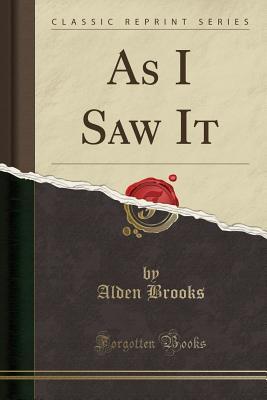
Brooks published his first book, The Fighting Men, in 1917. It consisted of a series of six short sketches depicting the respective psychological and behavioural traits of an ethnic group of soldiers, respectively English, Slav, American, French, Belgian and Prussian... His experiences of the war are (also) recounted in his 1929 book Battle in 1918, As Seen by an American in the French Army, published in the United States as As I Saw It.
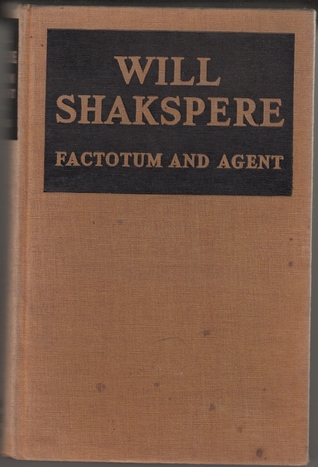
Aside from a novel, Escape (1924), Brooks wrote extensively on the Shakespeare authorship question, and in 1937 produced a preliminary volume, Will Shakspere: Factotum and Agent, in an attempt to prove that Shakespeare did not write the works attributed to him. In this book, Shakespeare is considered to be a pseudonym, and the sonnets are attributed to Thomas Nashe, Samuel Daniel, Barnabe Barnes and some other editorial hand. A contemporary scholar reviewing Brooks's ideas commented that although "there is absolutely no evidence to support any of his statements (this) disturbed neither Brooks nor his publishers."
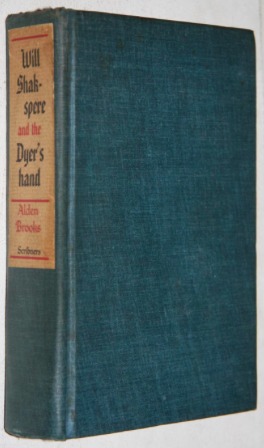
Six years later he fulfilled his earlier promise of identifying the supposed real author by publishing Will Shakspere and the Dyer's Hand (1943) declaring that Sir Edward Dyer was the true author...
Brook's vivid depictions of soldiers and war have been highly praised by specialists. Phillip K. Jason argues that he wrote "two of the most intriguing books about World War 1." His researches attempting to reveal Sir Edward Dyer behind Shakespeare have (however) usually been dismissed as fantasies.
- Wikipedia