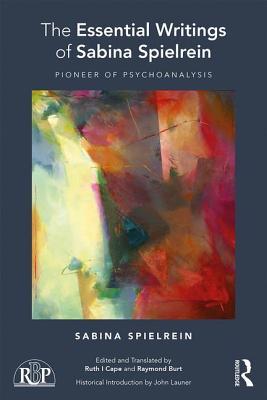
13 Published BooksSabina Spielrein
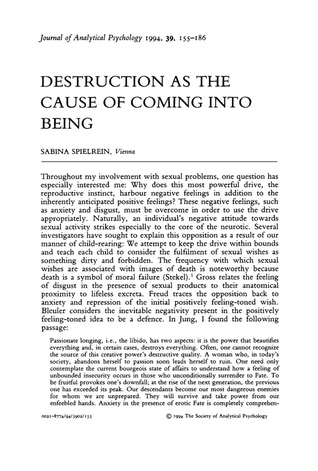
Sabina Naftulovna Spielrein (Russian: Сабина Нафтуловна Шпильрейн, also transliterated "Shpilrein" or "Shpilreyn") was a Russian physician and one of the first female psychoanalysts. She was in succession an analysand, then student, then colleague of Carl Gustav Jung, a man with whom she also had a romantic relationship. She also met, corresponded, and had a collegial relationship with Sigmund Freud. One of her more famous analysands was the Swiss developmental psychologist, Jean Piaget. She worked as a psychoanalyst and teacher in Switzerland and Russia. Her best known and perhaps most influential published work in the field of psychology is the essay titled "Destruction as the Cause of Coming Into Being".
Born 1885 into a family of Jewish doctors in Rostov-on-Don, Russia. Her mother was a dentist, her father an entomologist, who after moving from Warsaw to Rostov became a successful merchant. One of her brothers, Isaac Spielrein, was a Soviet psychologist, a pioneer of labor psychology. Spielrein was married to Pavel Scheftel, a physician of Russian Jewish descent. They had two daughters: Renate, born 1912, and Eva, born 1924.
Before enrolling as a student of medicine in Zürich, Spielrein was admitted in August 1904 to the Burghölzli mental hospital near Zürich, where Carl Jung worked at that time, and remained there until June 1905. While there, she established a deep emotional relationship with Jung who later was her medical dissertation advisor. The historian and psychoanalyst Peter Loewenberg argues that this was a sexual relationship, in breach of professional ethics, and that it "jeopardized his position at the Burghölzli and led to his rupture with Bleuler and his departure from the University of Zurich". Spielrein graduated in 1911, and was later elected a member of the Vienna Psychoanalytic Society. Her dissertation, “Concerning the Psychological Content of a Case of Schizophrenia,” was the first dissertation written by a woman that was psychoanalytically oriented. It was published in 1911 as the lead paper in the Jahrbuch der Psychoanalyse, which was edited by Jung. She continued working with Jung until 1912, and later saw Sigmund Freud in Vienna.
In 1923, Spielrein returned to Soviet Russia and with Vera Schmidt established a kindergarten in Moscow, nicknamed "The White Nursery" by the children (all furniture and walls having been white). The institution was committed to bringing up children as free persons as early as possible. "The White Nursery" was closed down three years later by the authorities under false accusations of sexual perversion with the children (in fact, Stalin actually enrolled his own son, Vasily, into the "White Nursery" under a false name).
Spielrein's husband Pavel perished during Stalin's Great Terror, as did her brother Isaac. She and her two children were killed by a German SS Death Squad, Einsatzgruppe D in 1942 in Zmievskaya Balka, together with another 27,000 victims.
While Spielrein is not often given more than a footnote in the history of the development of psychoanalysis, her conception of the sexual drive as containing both an instinct of destruction and an instinct of transformation, presented to the Vienna Psychoanalytic Society in 1912, in fact anticipates both Freud's "death drive" and Jung's views on "transformation"