10 Published BooksWilliam James Sidis
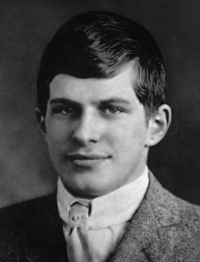
William James Sidis (April 1, 1898 – July 17, 1944) was an American child prodigy born to Jewish emigrants from Ukraine with exceptional mathematical and linguistic skills. He is notable for his 1920 book The Animate and the Inanimate, in which he postulates the existence of dark matter, entropy and the origin of life in the context of thermodynamics.
Sidis was raised in a particular manner by his father, psychologist Boris Sidis and mother, Sarah (Mandelbaum) Sidis, M.D., wished heir son to be gifted and believed in nurturing in him a precocious and fearless love of knowledge.
Sidis could read The New York Times at 18 months. By age 8, he had reportedly taught himself eight languages (Latin, Greek, French, Russian, German, Hebrew, Turkish, and Armenian) and invented another, which he called "Vendergood".
He entered Harvard at age 11 (graduating by 16) and, as an adult, was claimed to have an extremely high IQ (250-300, unconfirmed), and to be conversant in about 25 languages and dialects. Some of these claims have not been verifiable, but peers such as Norbert Wiener supported the assertion that his intelligence was very high.
Although the University had previously refused to let his father enroll him at age 9 because he was still a child, Sidis set a record in 1909 by becoming the youngest person to enroll at Harvard University. In early 1910, Sidis' mastery of higher mathematics was such that he lectured the Harvard Mathematical Club on four-dimensional bodies. Notable child prodigy, cybernetics pioneer Norbert Wiener, who also attended Harvard at the time and knew Sidis later stated in his book Ex-Prodigy: "The talk would have done credit to a first or second-year graduate student of any age...talk represented the triumph of the unaided efforts of a very brilliant child."
MIT Physics professor Daniel F. Comstock was full of praises. ‘His method of thinking is real intellect. He doesn't cram his head with facts. He reasons. "Gauss is the only example in history, of all prodigies, whom Sidis resembles". Further stating that Sidis would become the leading mathematician and a leader in that science in future.
Sidis began taking a full-time course load in 1910 and earned his Bachelor of Arts degree, cum laude, on June 18, 1914, at age 16.
According to The Prodigy: a Biography of William James Sidis, he briefly served at the League of Nations before leaving because U.S. president Woodrow Wilson would not withdraw troops deployed during the Great War. He was outspoken about his pacifism.
From writings on cosmology, to writings on American Indian history, to Notes on the Collection of Transfers, and several purported lost texts on anthropology, philology, and transportation systems, Sidis covered a broad range of subjects. Some of his ideas concerned cosmological reversibility and "social continuity".
In The Animate and the Inanimate (1925), Sidis predicted the existence of regions of space where the second law of thermodynamics operated in reverse to the temporal direction that we experience in our local area. Everything outside of what we would today call a galaxy would be such a region. Sidis claimed that the matter in this region would not generate light. Sidis's The Tribes and the States (ca. 1935) employs the pseudonym "John W. Shattuck", purporting to give a 100,000-year history of the Settlement of the Americas, from prehistoric times to 1828. In this text, he suggests that "there were red men at one time in Europe as well as in America".
Sidis was also a "peridromophile", a term he coined for people fascinated with transportation research and streetcar systems. He wrote a treatise on streetcar transfers under the pseudonym of "Frank Folupa" that identified means of increasing public transport usage.
In 1930, Sidis received a patent for a rotary perpetual calendar that took into account leap years.